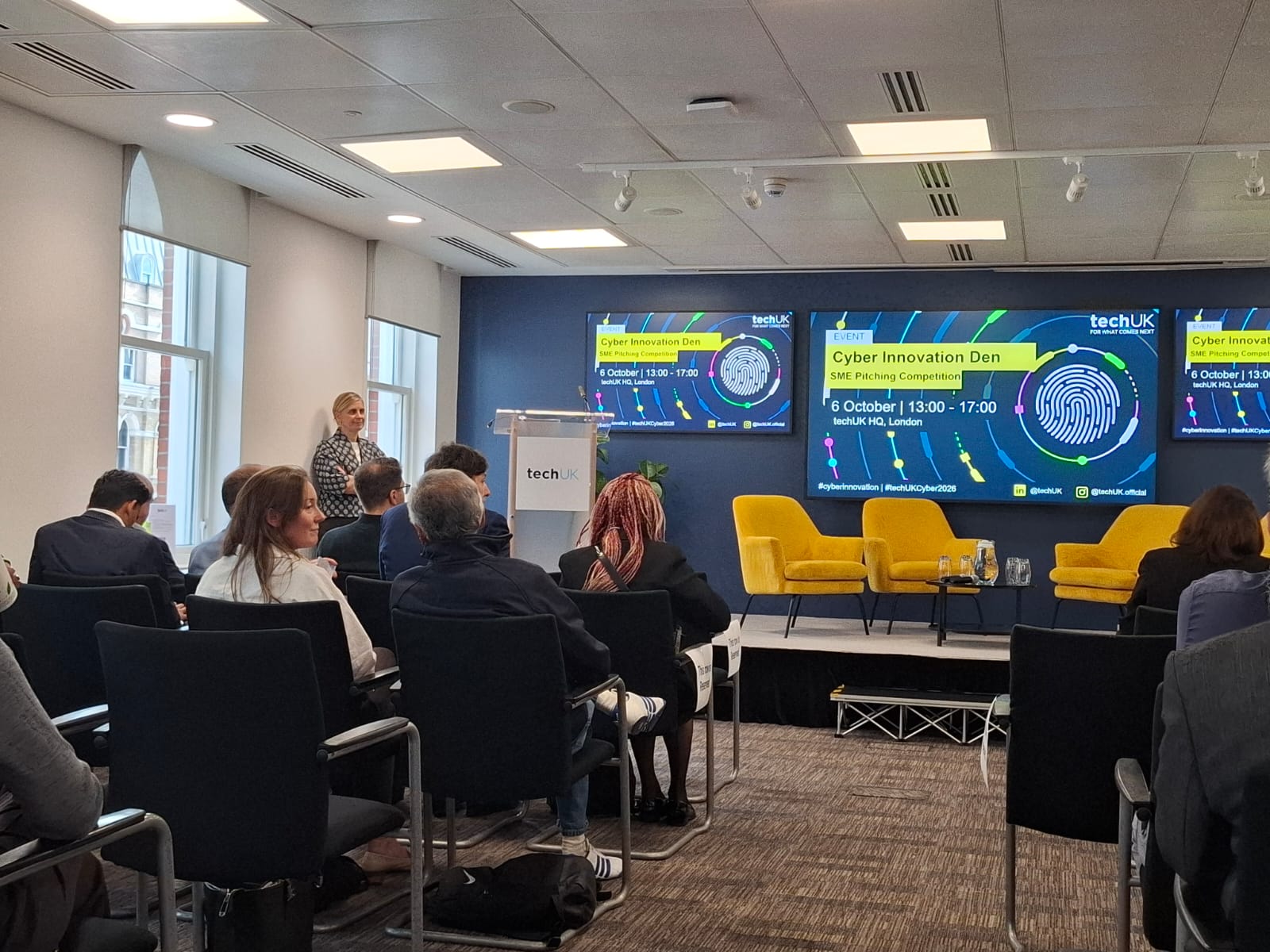
Yesterday’s techUK Cyber Innovation Den in London brought together start-ups, investors, policy makers and security leaders around a pressing challenge: turning UK technical invention into scalable, globally competitive cyber businesses.
Across the presentations and panel discussions, a clear shift emerged in how the industry approaches defense. Traditional perimeter dashboards are giving way to deeper validation layers embedded within hardware, operational networks, identity architectures and artificial intelligence models.
The New Definition of Supply-Chain Trust
Supply-chain security has expanded beyond software dependency lists. Yesterday’s ten pitching finalists demonstrated that modern supply chains encompass hardware integrity, continuous identity exchange, operational technology (OT), and AI internal mechanics:
- Physical AI and OT Plausibility: Aequus Tech introduced execution integrity for autonomous systems and critical infrastructure. Rather than looking solely for known signatures, their approach checks whether a reported system state is physically possible before automation acts. SafeTech Global’s OTShield complemented this focus on critical infrastructure by employing deception mechanisms to lure attackers away from live operational networks.
- Hardware Integrity: Ethicronics highlighted hardware supply chains, demonstrating software-based verification of printed circuit boards and silicon to catch counterfeit or altered components before deployment.
- Living Identity and Verification: Cavero Secure tackled credential hijack through continuous trust verification using post-quantum key exchange, while CyberSIARA showcased behavioural biometrics to differentiate real human interactions from automated bots without user friction.
- Engineering and Infrastructure Defenses: Ossprey focused on detecting malicious intent in open-source software packages before pipeline integration. Breachline pitched an autonomous security engineer for continuous testing, Teleformation introduced automated feedback loops for firewall rules, and RateYourCyber/Alfasoteria showcased AI-driven governance and risk quantification.
- In-Model AI Security: TIKOS moved beyond external guardrails by capturing causality traces from model internals at runtime to detect prompt injection and bias directly within LLMs.
Lessons for Emerging Cyber Founders
Panels featuring representatives from Innovate UK, Osney Capital, Plexal, Accenture, and NHS England outlined key operational advice for early-stage companies navigating the UK ecosystem:
Key Takeaways for Founders
- Anchor on Immediate Buyer Pain: Building impressive technology is no longer sufficient on its own. Successful products start with an acute operational problem that CISOs, OT operators, or healthcare buyers are actively trying to solve. Founders were encouraged to simplify their message and clearly pass the "one-sentence test" when explaining their value proposition.
- Design for Low-Friction Adoption: Large enterprises and critical infrastructure providers frequently reject solutions that demand disruptive operational changes. Security tools must make the secure path the simplest path for teams to adopt.
- Treat the UK as a Proving Ground: Panelists highlighted the UK ecosystem as an effective launchpad for global expansion. By validating tools through design partnerships, protected test harnesses, and trials with sophisticated UK buyers, start-ups can establish the evidence base needed to scale internationally.
- Ground AI Claims in Evidence: As AI accelerates development cycles, differentiation relies heavily on buyer access, execution velocity, and transparent data handling. Buyers and investors expect clarity around false positives, operational impacts, and data privacy—especially when AI is embedded directly into core workflows.
Moving Forward
The Cyber Innovation Den highlighted that securing complex digital supply chains requires verifying every layer of the technology stack. Supporting these emerging innovations through customer design partnerships, independent validation, and clear market access remains vital for strengthening broader national cyber resilience.
Strengthen Your Cyber Security Posture
We help organisations identify vulnerabilities, secure AI implementations, and audit critical infrastructure before threats emerge.
Neil Campbell is owner and operator at SME Cyber Solutions Ltd and a member of the Crimes Against Biz Policy Group for the FSB. He writes about AI, automation and practical technology infrastructure for UK SMEs.