Finance companies are at the heart of the UK economy, handling vast amounts of data and capital every second. In a sector where speed and accuracy are crucial, companies rely on powerful data systems to store, analyse and process information in real time. However, this reliance on advanced data infrastructure comes with significant cybersecurity risks that many financial institutions are failing to address.
Visualising the Threat: London's Financial Exposure
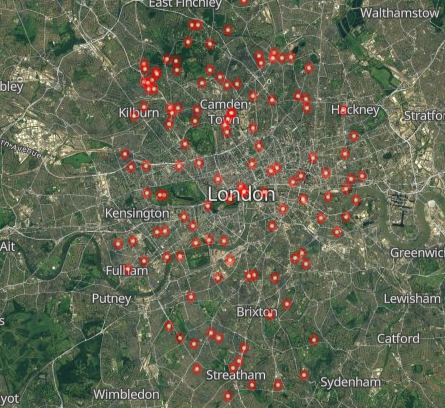
Visualisation of 200 publicly accessible systems across London's financial districts.
The map above, generated from real-world data using Shodan, highlights 200 publicly accessible systems associated with finance companies in London. Each point on the map represents a specific port carrying a service that attackers can easily target. The concentration of points in London’s financial districts is alarming; these are live, accessible systems, often configured without adequate security measures.
Why These Exposures Are Dangerous
These exposed systems are typically high-performance data platforms used for critical functions such as data aggregation, real-time market analysis, and log monitoring. Despite their importance, many of these systems are:
- Publicly Accessible: Reachable by anyone with basic internet tools.
- Lacking Authentication: Allowing unauthorised data access or manipulation.
- Unencrypted: Sending data in plaintext, making it vulnerable to interception.
The Real-World Impact
The consequences of these exposures are far from theoretical. Attackers actively seek out these misconfigured systems to steal financial records, manipulate market data, or deploy ransomware. Such breaches lead to significant financial damage and inevitable regulatory investigations.
Often, the root cause is a reliance on default settings or rapid deployments that bypass security testing. While operational pressure demands fast data access, security cannot be the price paid for speed.
Mitigating the Threat: Best Practices
- Restrict Public Access: Ensure internal data systems are never exposed directly to the internet.
- Robust Authentication: Implement multi-factor authentication (MFA) across all entry points.
- Full Encryption: Use SSL/TLS for all data transfers to prevent interception.
- Server Hardening: Disable default settings and enforce strict Access Control Lists (ACLs).
- Continuous Monitoring: Use real-time monitoring to detect unauthorised access attempts instantly.
- Regular Audits: Conduct frequent assessments to identify and close exposed services.
Securing the Financial Backbone
Financial institutions must strike a balance between high-speed data access and robust security. By taking proactive steps to secure their infrastructure, companies protect not only their assets and reputation but also the clients who trust them.
Concerned About Data Exposure?
If you are worried about your organisation's public footprint, our free security tools can help you identify gaps before attackers do.
Access Free Security Tools